
Blogs 05 2019 - 11 2019
Uri Smilansky
First days are always stressful, especially when your new colleagues seem to know everyone already, and are willing and ready to fulfil any request made of them. Such days are even more intimidating if one arrives four years into a project to be presented with a smooth-running operation which has established its own protocols and habits. But enough about me. This is not about the new team members at MALMECC: we have been warmly welcomed by both the existing team and the wider scholarly community during the project’s conference and got stuck straight in with the work. No, I am thinking of men such as Raoul de Vienne, lord of Louppy, who on Thursday, 9 October 1354, made his first contact with the court of the relatively new regime of King John II ‘the Good’ of France (1319-64, reigned from 1350 to his death). Raoul was by then an experienced courtier, having already served the previous monarch, Philip VI, yet, during the intervening years his services and personal life had been interwoven with the cause of Charles II ‘the Bad’ of Navarre (1332-87, reigned from 1349) during this turbulent period in French political history. Still, upon such first contact, Raoul—as would any aspiring courtier—would have needed to quickly assess the cultural environment of the court. A lack of proficiency in this could easily end up in missed opportunities if not actual trouble for anyone whose career relies at least in part on grace and favour. Tastes and fashions change, and keeping up both with patrons and competitor-courtiers was essential, then as now, in a corporate environment. A celebrated career as, among other responsibilities, Governor of the Dauphiné in the 1360s and 70s suggests Raoul’s success in this regard.
It is safe to assume that new arrivals at court did not go through an official induction process. Still, most courtiers would have already been trained, acculturated and active within broadly similar courtly environments. The specific need for assimilation upon arrival, therefore, would not have related to the underlying, systemic elements on which this culture was constructed, but on the subtleties differentiating this court, at this point of time, from any other. We all know how theory and practice differ in social situations, and how thin is the line between standing out and putting your foot in it. In both forming such cultural assessments and projecting their own identities, courtiers such as Raoul would have relied on fleeting, partial, and, indeed, accidental exposure to a court’s culture. By the placing of luxury artefacts at the foreground of the court’s operation, they would have suggested themselves as a primary port of call when making their judgements. In this process, immediately recognizable visual tropes communicating value and identity worked more efficiently than subtleties of details and their potential interpretations.
As part of my project, I am interested in this kind of exposure: in how we can understand its processes or analyze the effect objects had within this setting. Identifiers of courtly status and uniqueness could be very subtle and wide-ranging. They did not apply only to a court’s visual currency, and within that currency, not only to the kind of objects and visualities I intend to explore. My emphasis on books—and in particular, the subset of luxury books containing secular music—is due to their multiple ontologies. Their place in cultural discourse stretches over a wide range of interactions. At different times and contexts, they can be examined for their external material worth, size and craftsmanship; their internal artisanship and presentation; they can be contemplated for their contents on both the single-piece and collection level, their technique, and their emotional effect; within their content, they often act as commentators on their own cultural context; they can act as a focal point for performance, and as the starting point for debate beyond it. The concentration on music and secularity removes any vestiges of practical need, making their functionality and performativity purely cultural; through the peculiarities of musical notation and the demands of its performance, this also strengthens the performative element of books’ essence, weakening the claim of the private readers; finally, they engage with a further level of professional mediation, both copyists' and performers'. I hope to get to performance, audibility and close interpretation later on in the project. For now, I limit myself to exploring the effects of presentation, layout, font, and notational technique on the visual impact of such artefacts and the meanings such impact conveyed from the courtier point-of-view.
Raoul’s example is interesting also in this regard, as not only did he share political interests and a network of patronage with Guillaume and Jean de Machaut, but his name appears as one of the very few people to be named within Guillaume’s poetry. As it is often difficult to find evidence of cultural activities even for well documented figures, this link is really intriguing. Machaut’s multiple manuscript-collections of text and music are prime surviving examples of the kind of object I am pursuing. In looking at them, I ask not what they say about Machaut, but about their owners; I do not compare the quality of readings, but the effect of their general presentation. This releases my inquiry from the notion of ‘oeuvre’ or ‘urtext’, making sources usually dismissed as peripheral or partial just as relevant as those associated with the author himself.
Results to be reported in due course!
Uri
Further reading:
Raymond Cazelles, Société politique: noblesse et couronne sous Jean le Bon et Charles V (Librairie Droz, 1982).
Lawrence Earp, Guillaume de Machaut: A Guide to Research (New York: Garland, 1995).
Malcolm Vale, The Princely Court: Medieval Courts and Culture in North-West Europe, 1270-1380 (Oxford, 2001).
Following on from the first post in this series, in which David Murray discussed Pilgrim II’s circles in Avignon, he turns now to the members of Pilgrim’s court once he ascended to the Throne of St Ruprecht and became Archbishop of Salzburg.
Medieval Salzburg sat very much in the middle of things: in terms of secular geography, one might think of it as lying somewhere between Wittelsbach Bavaria and Habsburg Austria (and I wrote in my last blogpost about some of Archbishop Pilgrim’s familial connections with the Habsburgs). Alternatively, in terms of the fourteenth-century Church, Salzburg’s ecclesiastical direct influence extended from the middle of Bavaria, where Freising (near Munich) was the seat of a suffragan bishopric, to the north of modern Italy, where another Salzburg suffragan was the Bishop of Brixen. The bishop of Salzburg was also secular lord over much land in Styria, reaching into modern Slovenia. By another measure—as evidenced by Archbishop Pilgrim’s machinations in order to hasten the end of the Great Schism—the city on the Salzach lay in the overlap between the Pope in Avignon (or so Pilgrim said—his Chapter, by contrast, held true to Rome) and the King of the Romans in Prague.
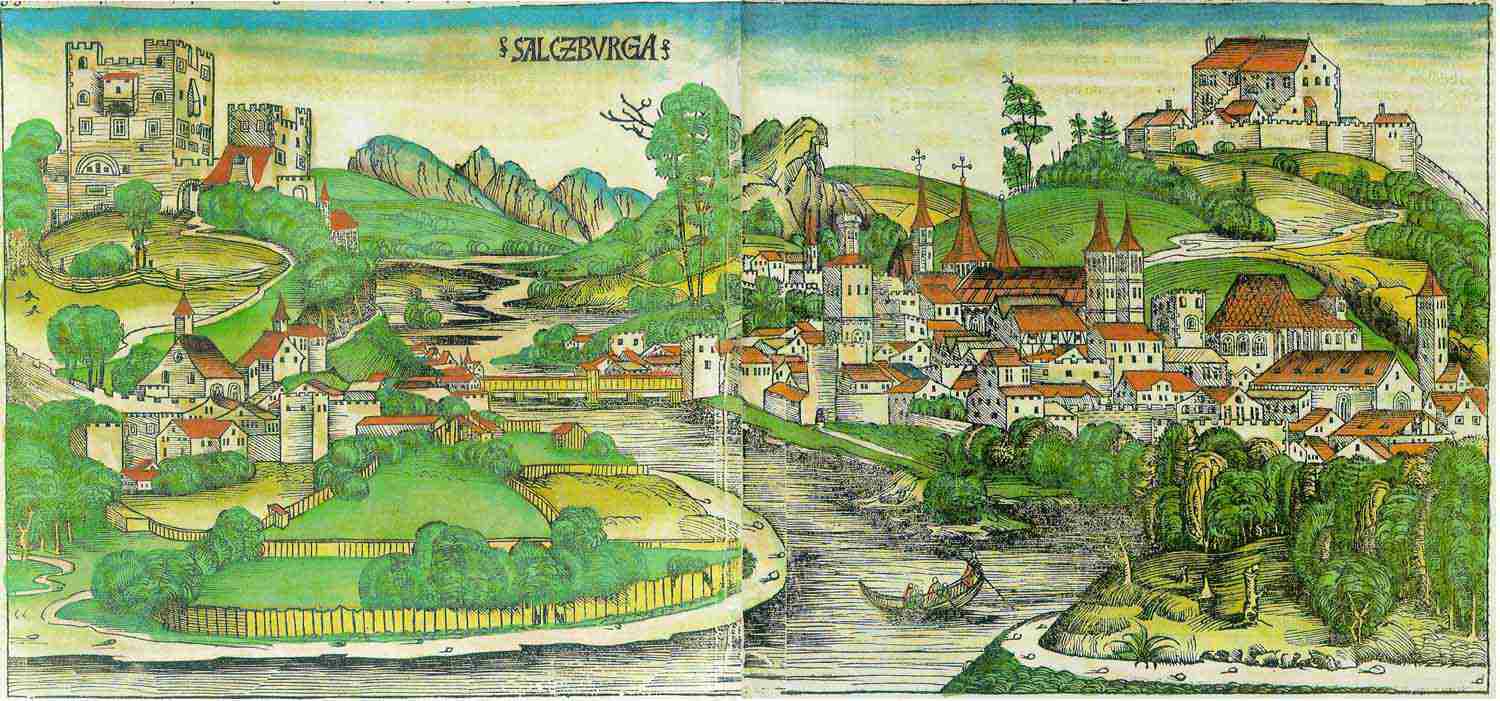
A view of Salzburg from Hartmann Schedel’s Weltchronik of 1493. Now Weimar, Anna-Amalia Bibliothek, Inc. 122
Just as the Hochstift as an institution can be thought of on multiple overlapping maps, so too were the individual courtiers and hangers-on around Pilgrim von Puchheim players in various different spheres. Two instances are particularly illuminating, and not least of all because they are individuals who were particularly close to Pilgrim. The first, Haug von Goldegg, to whom the rest of this post is devoted, was a secular member of the archiespiscopal court. My next post will be focussed on Wilderich de Mitra, Pilgrim’s chancellor and a cleric.
Haug von Goldegg was the last of a dynasty of Salzburg nobles, part of a class whose social position came from long years of service to the archbishops. Though the Goldeggs had come down in the world since their glory days in the early fourteenth century, they remained hereditary butlers to the Archbishop. They were still a force to be reckoned with at the end of the century, and that was all due to salt. Salzburg made much of its money from the production and shipping of salt, essential to the preservation of meat before the advent of refrigeration, and the Goldeggs were major players. Of the saltworks, four belonged to the archbishop, while others belonged to, or supported, the abbey of St Peter, Nonnberg convent, and the cathedral chapter in Salzburg (where Haug’s brother Wulfing had been a canon since the 1350s). The abbeys of Raitenhaslach (Bavaria) and Salmansweiler (Swabia, now better known as Schloss Salem) both had an interest in saltworks near Salzburg. But on their own, the Goldeggs owned five saltworks. It is hardly surprising then, that, when the main line of that family died out in 1400, the jostling of more distant relatives for a piece of this rather savoury pie was enthusiastic.
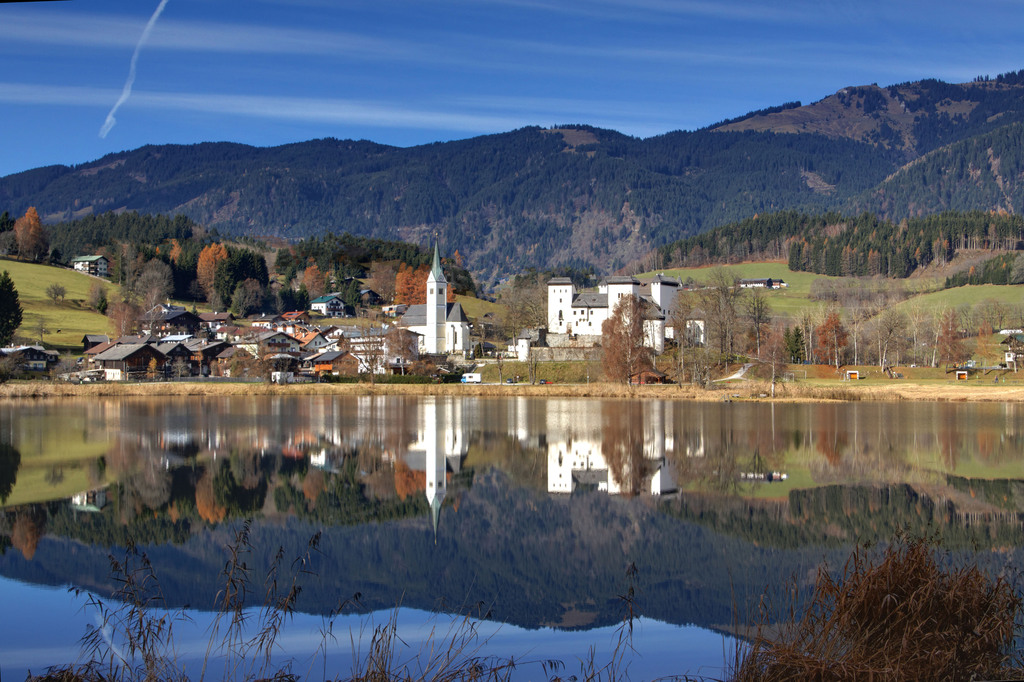
The Castle and Lake at Goldegg. The present Castle goes back to a fortress built from 1323 by Wulfing, grandfather of Haug and close ally to the earlier Salzburger archbishop Friedrich III von Leibnitz.
Haug was clearly a close associate of Archbishop Pilgrim. It is tempting to put this down to a similar taste for display. For instance, when Pilgrim travelled to meet the Dukes of Bavaria in 1387 at the abbey of Raitenhaslach (a meeting, incidentally, that ended with Pilgrim being held hostage by the Bavarians for several months), the two travelled together in some style:
Pilgrim was accompanied by 34 knights and noble pages, partly members of his Council and of the Salzburg Stiftsadel, partly squires of the Hofgesind, his entourage of armed mercenaries. There were also guards, chamberlains and two pipers, then the servants of the noblemen. The most distinguished of Pilgrim’s companions, Sir Haug, the last of the Goldeggs, himself had another four knights and six pages with him (Klein 1972/73: 50-51; my trans.).
Haug also interacted with other members of Pilgrim’s court. For instance, Pilgrim’s steward Reicher von Rastat re-founded the church of the Virgin at Altenmarkt in the Pongau valley (you can see an earlier post of mine about Reicher and the Virgin elsewhere on this page), and following the fourteenth-century devotion to the Holy Family, built a new chapel dedicated to Sts Anne and Achatius, one of the Seven Holy Helpers.
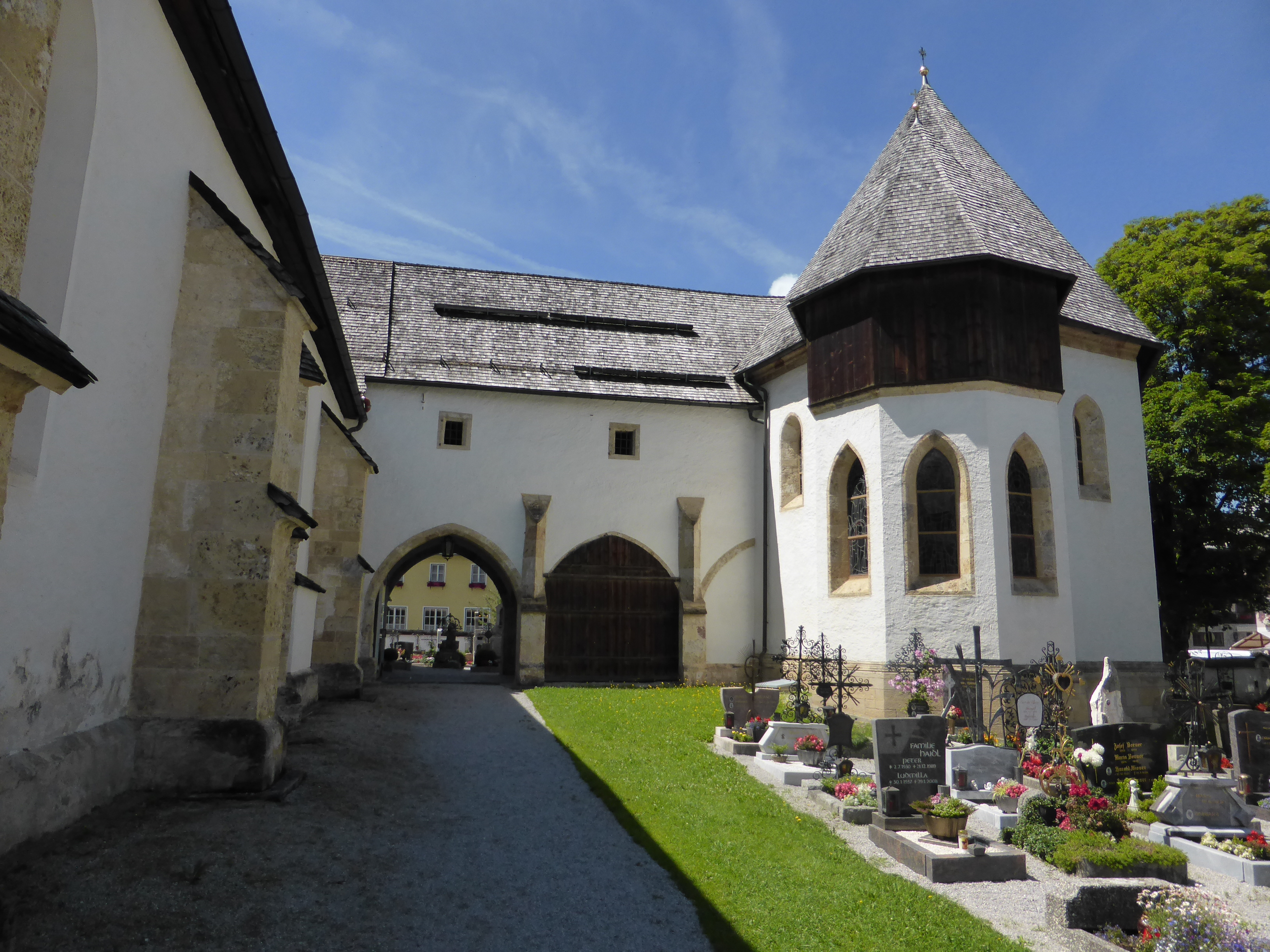
The chapel of Sts Anne and Achatius in the churchyard at Altenmarkt.
Haug von Goldegg, himself closely linked with the Pongau as it was the centre of his family’s lands, is mentioned in a charter of 1398 as giving extensive lands to Reicher’s chapel and the associated confraternity of St Anne in Altenmarkt (Martin 1947: 50). This may well be thought of as an ailing man (as noted already, he died only two years later) who was experiencing extreme financial difficulties at the time, making sure that things were a little better on the other side. The fact that Haug did this by supporting the religious work of Reicher, who, as magister curie, oversaw Pilgrim’s extensive domains, is suggestive of his well-connected place in the Archbishop’s circle. Haug’s own indirect religious donations were made to pay for a weekly Mass at the church in Goldegg. A charter of 1375 shows them releasing lands to be given by Marchart der Pründlinger to the parish of St. Veit im Pongau, a town around four miles away.
If it is reasonable (and I leave the question open to you…) to judge someone by the company they keep, Haug von Goldegg, last of his dynasty, might be thought as the perfect counterpart to Pilgrim. Both were without direct heirs, but nonetheless engaged in the sometimes desperate attempt to shore up or expand their empire. Both of them, although this is hardly unusual in the fourteenth century, took steps to ease their fate after death (Pilgrim established a spectacularly well-endowed chapel next to the Cathedral), and both were given to a certain amount of ceremony as they thought befitting their status.
In my next post, I turn to another figure who seemed to gain Pilgrim’s respect, the doctor in decretis, Wilderich de Mitra.
Further reading:
Klein, Herbert, ‘Der Streit um das Erbe der Herren von Goldegg’, Mitteilungen der Gesellschaft für Salzburger Landeskunde, 82/83 (1942/1943), 1–48
Klein, Herbert, ‘Erzbischof Pilgrim II. von Puchheim (1365-1396)’, Mitteilungen der Gesellschaft für Salzburger Landeskunde, 112/113 (1972/1973), 13–71
Martin, Franz, Salzburger Archivberichte 2.2 Politischer Bezirk Bischofshofen, Beihefte zu den Mitteilungen der Gesellschaft für Salzburger Landeskunde, 2 (Salzburg: Gesellschaft für Salzburger Landeskunde, 1947)
Schneider, Christian, Hovezuht: Literarische Hofkultur und höfisches Lebensideal um Herzog Albrecht III. von Österreich und Erzbischof Pilgrim II. von Salzburg (1365–1396) (Heidelberg: Winter, 2008)
Vones, Ludwig, Urban V. (1362-1370): Kirchenreform zwischen Kardinalkollegium, Kurie und Klientel, Päpste und Papsttum, 28 (Stuttgart: Hiersemann, 1998)
In this series of three posts, David Murray writes about some of the connections between his favourite Archbishop of Salzburg, Pilgrim II (r. 1365-1396), and other figures in the medieval Church, as well as some of Pilgrim’s secular allies.
The Puchheim were a well-established family of ministeriales with close ties to Vöcklabruck in Styria, and had long entertained connections with the archbishops of Salzburg. But it was to the Habsburg dukes of Austria that they owed their allegiance, and so they had re-located to Lower Austria in the thirteenth century to be closer to Vienna. Their devotion to the dynasty was rewarded by being named to the office of Hereditary Steward in 1276. (Holders of this office received tribute in the form of pelts from monasteries, whereas towns, amusingly enough, were expected to offer a sturgeon.) They remained distinguished figures on the Austrian scene well into the eighteenth century, when the last of the direct line, Anton, Bishop of Wiener Neustadt, dies in 1718.
Credit: © Salzburg, Archiv des Erzbistums Salzburg, n. 421 (1372 II 25)
The biography of Pilgrim von Puchheim, who rose to be archbishop of Salzburg, is rather sketchy in its early years. He was probably born in the 1330s, the younger son of Pilgrim IV’s second marriage to Elisabeth von Trautmansdorf. As the younger son of a second marriage, it was perhaps unsurprising that he was destined for the Church. By 1353 he was a member of the cathedral chapter of Salzburg (when his brother gave him the revenues coming from lands at Wulffingstein), although he only received priestly orders the following year. The fact that this happened at the hands of Nicola Morosini in Castello, one of the islands of Venice, could indicate that Pilgrim was studying at Padua, renowned for its teaching of canon law.
It is, however, certain that Pilgrim studied canon law at the University of Avignon. This was an unusual choice for someone from the Habsburg lands, as they tended to favour Bologna or Paris, or, later, Prague and Vienna. With the exception of a dispute in the early 1360s about the payment of his canonical income during his studies, the next thing we hear about Pilgrim is when has was named papal chaplain to Urban V in October 1363. After a contested election in 1365, Pilgrim was provided with the archiepiscopate of Salzburg on St Andrew’s Day of the same year.
So there is a long period when we cannot say a great deal for certain about Pilgrim’s activities. Herbert Klein, author of one of the most extensive studies of Pilgrim’s life, names one particular figure as an important protector to Pilgrim during this period. He is Guillaume d’Aigrefeuille the elder, known as the Cardinal of Saragossa. Through him, Pilgrim can be seen making his way into a Limousin faction at Avignon that would colour his politics and diplomatic choices throughout his reign.
Paris, BnF, lat. 11907, ‘Les papiers de Montfaucon’, f. 244.
A 1726 drawing of the tomb of Guillaume d’Aigrefeuille the Elder in St Martial in Limoges
The Aigrefeuille dynasty was one of the most successful and omnipresent in papal Avignon, a fact no doubt aided by their being cousins to Clement VI. The careers of a single set of brothers, the sons of Guillaume d’Aigrefeuille, makes clear just how spectacular their good fortune was:
- The eldest son, Aymar, became Marshall of the Papal palace in 1362.
- Guillaume (that is, the son of Guillaume—inventive naming, there), who is thought to have been protector to Pilgrim von Puchheim, had received his cardinal’s hat by 1350, and went on to become camerlengo in 1363.
- Pierre was Bishop of Clermont and Uzès. His vicar-general was Guillaume de Grimoard, who went on to become Urban V, under whose reign Pierre became bishop of Avignon.
- Raymond was Bishop of Rodez until his death in 1361.
- The youngest son of the generation, Faydit, took over from his brother Raymond as Bishop of Rodez, before going on to inherit the bishopric of Avignon from his other brother Pierre. Talk about hand-me-downs … His career led to a cardinal’s hat in 1383.
https://www.horizon-provence.com/avignon-museum/petit-palais-museum-avig...
The Petit Palais, residence of the Bishops of Avignon, including Pierre and Faydit d’Aigrefeuille
The next generation of ecclesiastical Aigrefeuilles was less numerous, but no less successful. Aymar’s son, yet another Guillaume, also rose to the College of Cardinals. This third Guillaume, papal diplomat and jet-setter (or, more likely, donkey-sitter), would later be party to one of Pilgrim’s great wheeler-dealer exploits: the attempt to end the Great Schism.
Paris, BnF, Estampes et photographie, N-2
An early modern imagining of the face of Guillaume the younger
Clement VII appointed the younger Guillaume d’Aigrefeuille to act as his envoy to Charles V, who received him at Vincennes in May 1379. He then spent the next six years travelling the Empire, trying to win over princes for the Avignon observance. Pilgrim, along with his ally Leopold III of Habsburg, was one of the major Avignon agitators in Central Europe. Indeed, Guillaume d’Aigrefeuille had planned to attend the Salzburg provincial council in 1380 when Pilgrim hoped to convert his see to Avignon. Neither the visit nor the conversion came to fruition. But (as a future blogpost in this series will show), Guillaume the Younger was in a position to help Pilgrim by helping his respected chancellor Wilderich de Mitra when he was accused of being schismatic. All of this to say, then, that even in cases where we do not know very much about exactly what a person did, knowing who they knew can also be highly enlightening.
The Tour St-Jean, part of the remains of the livrée of Guillaume d’Aigrefeuille the Younger.
Further reading:
- Creytens, ‘Le “studium romanae curiae” et le maître du sacré palais’, Archivum Fratrum Praedicatorum, 12 (1942), 5-83
- Klein, Herbert, ‘Erzbischof Pilgrim II. von Puchheim (1365-1396)’, Mitteilungen der Gesellschaft für Salzburger Landeskunde, 112/113 (1972/1973), 13–71
- Lackner, Christian, Hof und Herrschaft: Rat, Kanzlei und Regierung der österreichischen Herzöge (1365-1406), Mitteliungen des Instituts für Österreichischen Geschichte, Ergänzungsband, 41 (Vienna: Oldenbourg, 2002)
- Steinherz, Samuel, ‘Das Provincial-Concil von 1380’, Mitteilungen der Gesellschaft für Salzburger Landeskunde, 39 (1899), 83–110
- Vones, Ludwig, Urban V. (1362-1370): Kirchenreform zwischen Kardinalkollegium, Kurie und Klientel, Päpste und Papsttum, 28 (Stuttgart: Hiersemann, 1998)
After a series of study days held in Oxford, the MALMECC team co-organized a conference at the University of Liège with the local research unit Transitions: Moyen Âge et première Modernité. Focused on the much debated question of ‘Transnationalism’, it gathered researchers from both the continent and from the UK. Speakers continuously crossed disciplinary borders and historiographical traditions, creating great discussions during the conference and dinner.
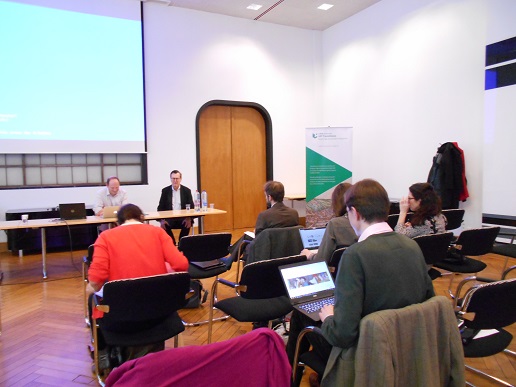
After welcoming speeches by Marie-Élisabeth Henneau (co-director of Transitions) and Karl Kügle (MALMECC Principal Investigator), the audience quickly entered the main conference theme, Transnationalism and fourteenth-century Europe. Through the case study of the late medieval Luxemburg dynasty, Michel Margue and Eloïse Adde addressed the central question 'is it relevant to use the modern concept of "Transnationalism" when studying a period, the Middle Ages, which did not know "nations", in the sense of the modern concept?' The answer seemed to lie in the multiple tensions that continuously shaped medieval courts around multi-faceted, successive or simultaneous, cultural influences. 'Transnationalism' was a phenomenon first conceived in the modern sense in the context of the geopolitics of the 1960s. It was intended to take into account political actors that were not themselves national states—even if some of them ultimately so—but nonetheless had an important role in politics (e.g. during the decolonization process).
The concept of transnationalism may thus help us to understand that there was no such thing as a clear, homogeneous and undebated courtly identity in the Middle Ages. The weight of cultural actors did not depend on how close they were to the centre, and peripheries could also create lasting models, which were sometimes adopted by the centre itself.
Nicola Morato then drove discussions concerning the difficulty of following the popularity of a text throughout its history. Reflecting on the Guiron cycle, he convincingly proposed than in order to get a better idea of this, we could use the stemma codicum. This kind of genealogical tree was originally created to follow the evolution of a text through history, each major change in it creating a new 'family'. But this could also be used to consider which versions remained appreciated without major changes and how cultural context could explain major or minor, changes in texts (i.e. by introducing, reshaping or cutting off episodes).
Alain Marchandisse showed, through a careful study of marriages organized by the Burgundian Valois dynasty (and more particularly some that involved their allies, the Rheinish family of the counts of Cleves), that weddings created the space for cultural transfers, but also that finding 'foreign' husbands or wives was a way of strengthening a political power inside given geographical limits.
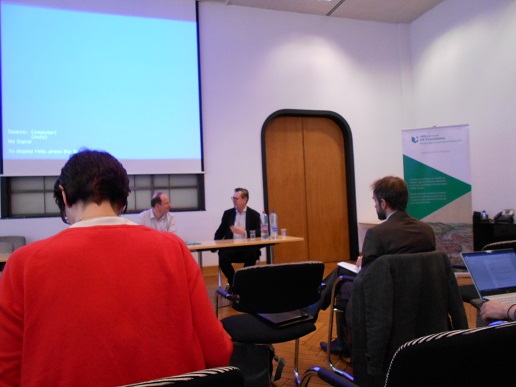
After a well-deserved lunch, two members of the MALMECC team introduced their research. David Murray emphasized how Pilgrim, Archbishop of Salzburg, was a witness, if not a supporter, of the introduction of French, and more largely Latin musical and literate models into a Germanic city. This echoed what was discussed before, that there was hardly such a thing as a definitive and geographically-driven courtly model (or models) in fourteenth-century Europe.
Laura Slater then thoroughly illustrated how counts of Namur, in modern-day Belgium, proved keen to emulate English fashion. They ordered several sets of needlework following the opus anglicanum (the English way). This was not just a political statement, it seems, even if there were regular and strong connections between the Low Countries and England at the time. Aesthetic choices clearly went from one place to another as long as they looked nice, or should we say prestigious, enough to potential owners. This prevented the emergence of an overwhelmingly local, pre-national taste, and encouraged long-distance cultural transfers.
Mario Damen was the last speaker of the day. He dedicated his talk to a well-known, and very cinematographic expression of late medieval courtly life, tournaments. Going beyond the Huizinga view of a declining chivalry fooling itself with pointless ceremonials, Mario rightfully highlighted how these events were key in the ongoing reconfiguration of noble identity, amongst other things in its relationships with an ambitious, and possibly stronger than ever, overlord, in this case the Duke of Burgundy, later succeeded by the Holy Roman Emperor Charles V.
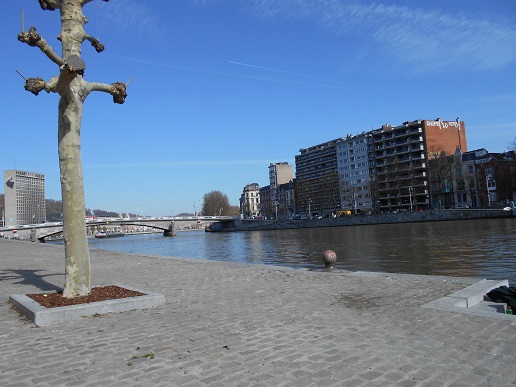
The second day of the conference started with a series of trips between Savoy and England, following the paths of Savoy military architects to Wales and English chivalric offerings to the Alpine earldom. Eva Pibiri made a case for how strong mutual influences partly shaped late medieval martial and chivalric practices. Savoy appears as an ideal model to understand how a princely court could serve as a crossroads of various influences.
Karl Kügle went on crossing borders by following ecclesiastics and music practitioners who did not confine their musical career to a single geographical area. Karl convincingly demonstrated that this approach appears to have been key not only for reaching high positions, such as Pope, but also for ensuring the circulation of musical models.
In the last session, Christophe Masson studied the courts of the Avignon cardinals using transnationalism. He argued that cardinals contributed to the survival of the late medieval Church organization, and ensured their role inside it, by merging multiple influences into their cultural practices. Far from slavishly replicating their diplomatic choices, culture was used by cardinals to express that they were not just 'nationals' from a given kingdom or principality but were strengthening and defending the universal power of the Church.
The last speaker of the conference was Jane Gilbert. Echoing the first presentation, she explored how the creation of noble or dynastic identities was produced by a constant dialogue between a number of actors. Moreover, the case she discussed, the one of an Alexandre manuscript, offered numerous examples where creators of the actual volume (that is scribes and painters) showed themselves shaping these aristocratic identities, through marginal illustrations and even inside the text itself.
The conclusions were delivered by Eric Bousmar. Amongst the several points he emphasized and connections he made, it is worth keeping in mind that courts were a nexus. Often ‘composite’, that is created by a personal union of various territories (see the dominions of the Dukes of Luxemburg or Burgundy), late medieval polities may have gathered several courts, instead of merging all of them into one, as it was the case in 'complete states' (such as the Kingdom of France). Nonetheless, personal union and complete state appear quite close to each other on several levels. The number of transfers occurring at courts were extremely numerous. The non-existence of a (pre-)modern state did not prevent either local identity or shared cultures from developing. Additionally, all of these influences had so many origins (family, education, political obligations or ambitions, careers, personal experiences, to name but a few) that they should be considered as complementary, not as hierarchical.
Transnationalism may thus be one of the tools we need to properly understand how states interacted in the Middle Ages, and how they were seen by fourteenth-century courtiers.
The MALMECC project would like to thank all organizers and participants for their help in making the conference a success. We look forward to seeing you again soon.
In this post, David Murray writes about the importance of the Virgin Mary in and around 14th century Salzburg.
It would be an understatement to say that the fourteenth century was quite keen on the Virgin Mary.
In Salzburg, the parish church, now known as the Franziskanerkirche, was dedicated to the Virgin, as were the Nonnberg convent near Salzburg and the Eigenkloster at Admont in Styria. Mary is also, unsurprisingly, heavily represented in the religious songs that were composed at the court of Archbishop Pilgrim II and transmitted to us attributed to the anonymous ‘Monk of Salzburg’. The religious pieces combine a varied selection of translations of Latin hymns and sequences from the liturgy with more idiosyncratic compositions and pieces sharing characteristics with the German Meisterlieder of the time. Of the forty-nine religious songs in the corpus, twenty are devoted to the Virgin.
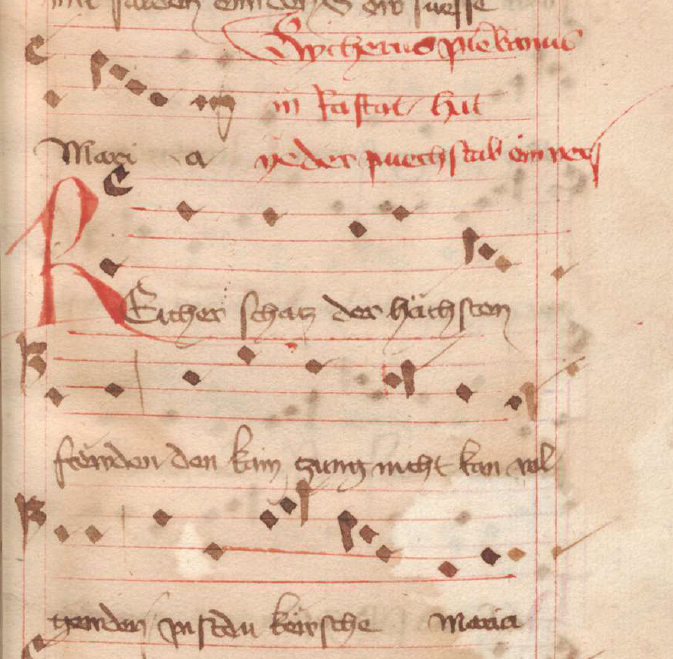
‘Richer schatz der höchsten freuden’, in Munich, Bayerische Staatsbibliothek, Cgm. 715, f. 12r.
Two of the sequences speak particularly eloquently to the value of Marian devotion in Salzburg. One, entitled ‘Plum gezartet, ros an doren’ (‘Delicate flower, rose without thorns’), is decorated with an acrostic so that the first letter of each versicle together spell PYLGREIM ERCZPISCHOF LEGAT, a clear reference to archbishop. Another, ‘Reicher schatz der höchsten freude’ (‘Rich treasury of the greatest joys’) has an acrostic reading RICHERUS PLEBANUS JN RASTAT.
We can identify this Richerus as Reicher von Ettlingen, mentioned in 1384 in the liber vitae of St Ruprecht (that is, the book in which the cathedral community recorded the name of the souls for whom it was to pray) as being rector parrochialis ecclesie Rastat et quondam magister curie. A Member of a Bavarian noble family, Reicher, as Hofmeister, was responsible for managing the central portions of the archiepiscopal estates.
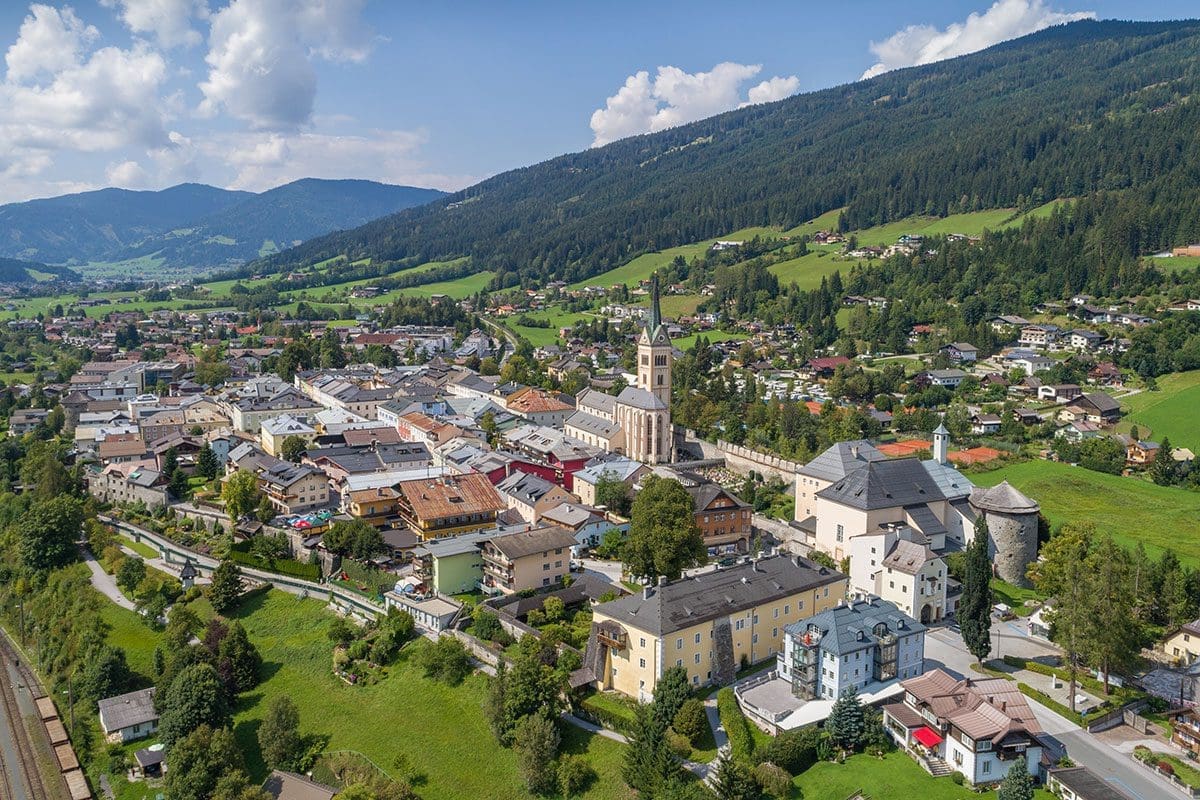
Rastat (now spelled Radstadt) in the Pongau valley was, as the impressive town walls still demonstrate, an important centre for archiepiscopal authority.
The song, ‘Reicher schatz der höchsten freuden’ has a particularly ornate text, with rhyme upon rhyme mirroring the unlimited joys as well as the help that Mary was thought to offer worshippers. For example, the third double versicle reads:
Engelischer gruss dich grüsset,
götlich süss dich übersüsset,
dein suss wais chain pitterkhait
The angelic greeting greets you
divine sweetness makes you sweet all over
your sweetness knows no bitterness
Reicher seems to have been particularly devoted to Mary, and his devotions extended far beyond song: his seal shows a Virgin of Mercy, with Mary sheltering the people under her cloak (a popular piece of Marian imagery that is also picked up in the Monk’s song). Perhaps most striking though is the statue of the Virgin and Child that he appears to have acquired in 1393 for the parish church at Altenmarkt. The statue, which stands at 80cm in height is a particularly fine and relatively early example of the so-called Beautiful Madonna. I recently made an academic pilgrimage to Altenmarkt to visit the statue.
The Altenmarkt Madonna in close-up.
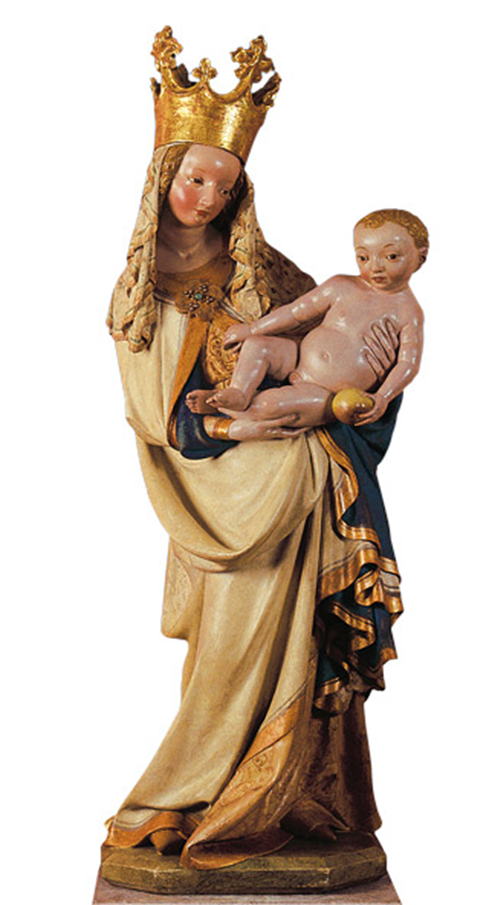
The date for the statue’s arrival in Altenmarkt can be deduced from an indulgence promising the remission of forty days for all those who prayed before this particular statue, signed by the papal nuncio Ubaldino de Torres in Prague. This may or may not align with the three trips that Pilgrim von Puechheim made to Prague to try to win over King Wenceslaus for the Avignon obedience. In the seventeenth century, the statue is recorded as having been on display ‘on a pine tree’ in the churchyard. (The image of an enormous, year-round Christmas tree in Altenmarkt, complete with Marian angel-replacement is rather terrific. But given that the statue is made of cast stone, and thus not of the lightest, this picture does not seem entirely likely. Suggestions on a postcard please…)
Indeed, so prominent is Mary that she makes her way into songs where, normally at least, she would not be expected. For instance, ‘Sälig sei der selden zait’ (‘Blessed be the time of salvation’) is a contrafactum of a Latin sequence with the title ‘Mundi renovatio’. (Contrafacta are songs sung to the tunes of already existing songs; so, for example, ‘The Red Flag’ is a contrafactum of ‘O, Tannenbaum’.) The text of ‘Mundi renovatio’ is a very well-known celebration of the Resurrection and thus focussed on Jesus and Easter, and may have been composed at the Abbey of St Victor, responsible for something of a revolution in sequence composition in the twelfth century. By contrast, the German text composed to be sung to this melody in Salzburg is as much concerned with the Virgin as it is with Christ. Mary, it proposes is actually an essential part of Easter, because without her, there would have been no Jesus to crucify. By singing this text with a shifted focus to an older tune that many people would know to ‘mean’ something rather different, the poet was able to blend together two ideas into one new song.
The Altenmarkt pietà, c.1410-1420.
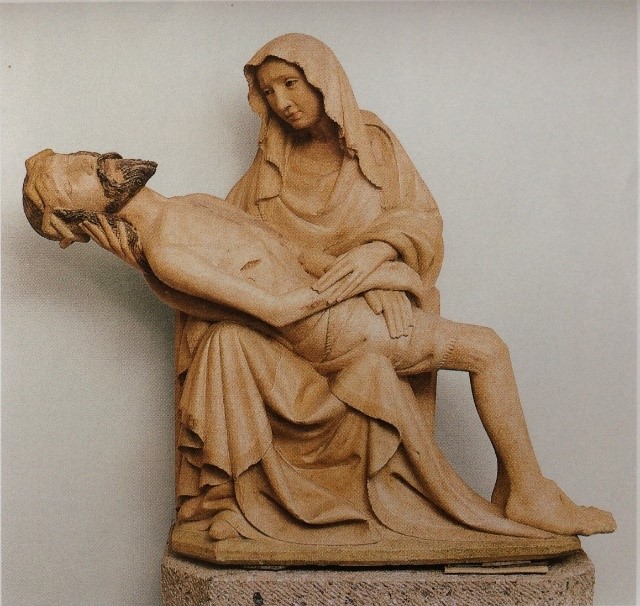
Another late medieval sculpture in Altenmarkt, which dates from after Reicher von Rastat’s tenure (it seems to date from the first fifth of the fifteenth century), is an example of a very popular version of the pietà, in which the Virgin holds the body of the crucified Jesus.
The book-end to the Madonna and Child, the pietà, or Vesperbild as it is called in German, it speaks of an intense engagement with the Easter story in this corner of the world, of a kind also found in one of the more unusual pieces of the Monk of Salzburg.
‘Die nacht wirt schir des himels gast’ (‘The night will soon leave the skies’), narrates in vivid manner the events of the Passion, with one strophe for each of the canonical hours (matins, lauds, prime, terce, sext, nones, vespers, and compline).
The strophe for vespers ends with these lines:
man legt in da mit jammer groß
Maria toten in ir schoß.
vil haisser zäher sie vergoß
und halst in minneclich.
sie kusst in oft in irem laid
und sprach: ‘mein liebste augelwaid,
mein chind, so ich nun von dir schaid,
wer sol dann trösten mich?’
sie wand vor laid ir weissen hend
mit innerm seufzen ser:
‘ich bin so jemerlich ellend
und enwaiß wo ich hin ker.’
They lay him there, with great anguish,
Dead in Mary’s lap.
Many hot tears she shed
And embraced him with love.
She kissed him often in her sorrow,
And said, ‘My dearest darling,
My child, now that I leave you,
Who will be my comfort?’
She turned her white hand for sorrow,
With deep and inmost sighs.
‘I am so miserably anguished
And do not know where to turn.’
The fervour behind Marian devotion in fourteenth-century Salzburg and its area of influence, then, crossed the boundaries between media and points to an immersive religious experience for the worshipper. The vividness of the statuary in circulation (look, for instance, at the way the Madonna’s fingers depress the flesh of the infant Jesus in the Altenmarkt Madonna) echoes both the grandeur and the emotionality of the songs dedicated to Mary which are attributed to the Monk of Salzburg. Mary, then, was present to her worshippers in music, words, and physical representations, and at all points in-between.
Further reading
Hamburger, Jeffrey, ‘Rahmenbedingungen der Marienfrömmigkeit im Spätmittelalter’, in Schöne Madonnen vom Rhein: Eine Veröffentlichung des LVR-LandesMuseums Bonn, ed. by Robert Suckale (Leipzig: Seeman, 2009), pp. 121-137
Kvapilová, Ludmila, Vesperbilder in Bayern von 1380 bis 1430 zwischen Import und einheimischer Produktion (Petersberg: Imhof, 2017)
März, Christoph, Die weltlichen Lieder des Mönchs von Salzburg: Texte und Melodien (Tübingen: Niemeyer, 1999)
Spechtler, Franz Viktor, Die geistlichen Lieder des Mönchs von Salzburg (Berlin & New York, De Gruyter, 1972)
In the second of her blog posts on Aachen Cathedral, Laura Slater muses on some of the pieces in the Aachen Cathedral Treasury, and Charles IV's penchant for relics...
Later medieval rulers from across Europe looked up to Charlemagne as an exemplary, even holy ruler of Christendom. Charlemagne was canonised as an (unofficial, locally rather than papally recognised) saint in 1165 by Emperor Frederick I Barbarossa. The glittering shrine of Charlemagne was completed in 1215 at the coronation of Emperor Frederick II of Hohenstaufen, who added the final nail.
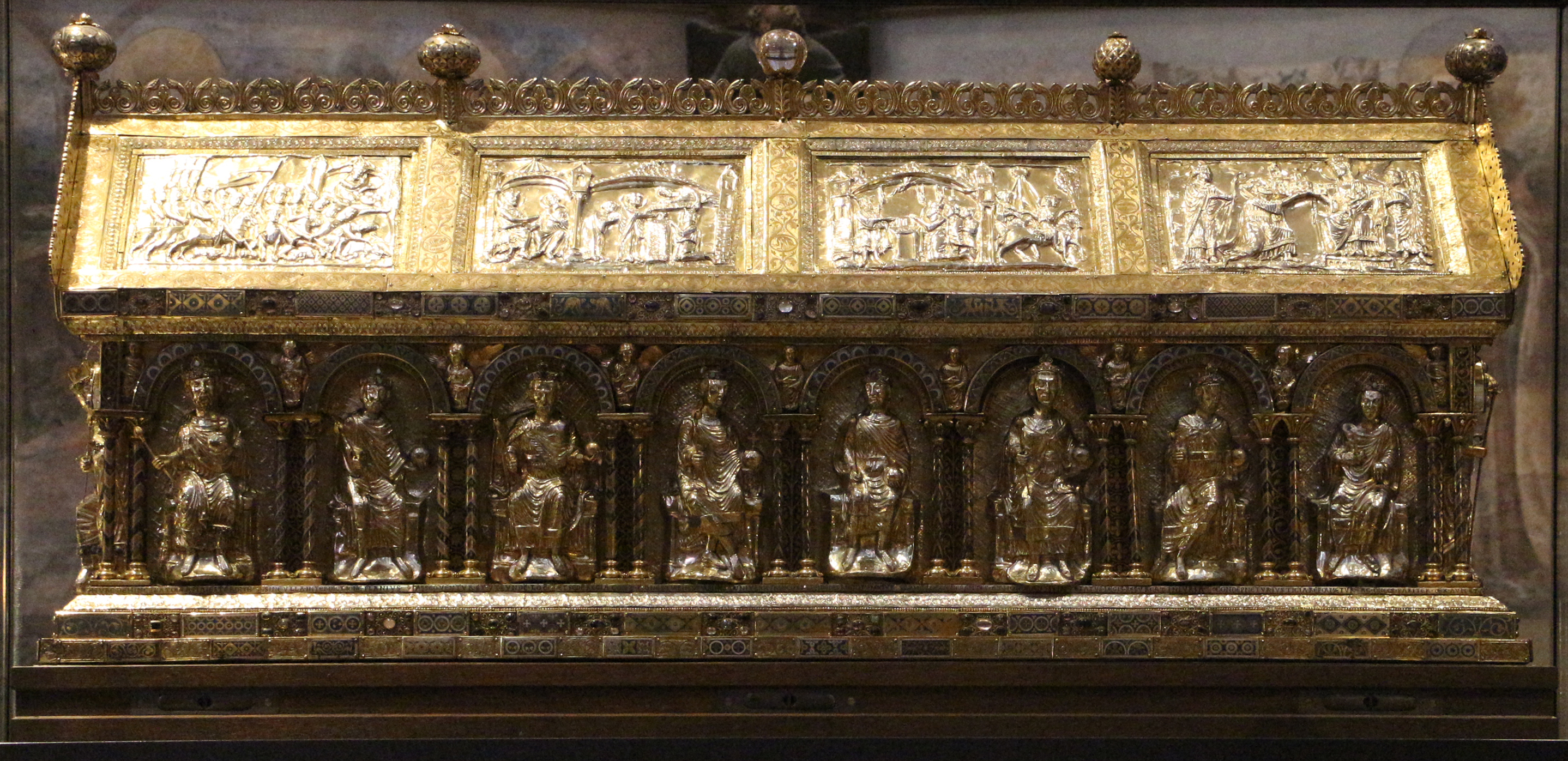
The shrine of Charlemagne (please click for more detail)
It looks like a miniature church, but there are no saints seated under the gilt arcade, as we might expect for the tomb of a holy man. Instead, each side of the shrine depicts eight successors of Charlemagne. At the front of the shrine, we see Charlemagne enthroned, flanked by smaller, standing portraits of churchmen. The shrine forms a grand celebration of secular, imperial power and the special status of the Holy Roman Emperors.
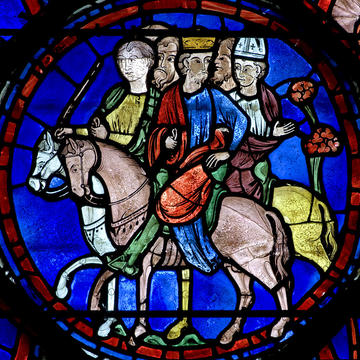
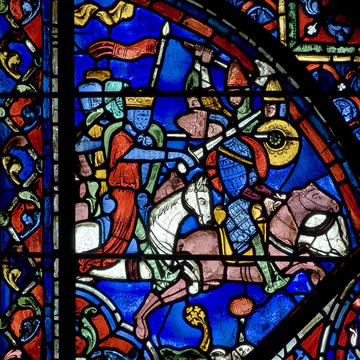
According to later medieval legends, Charlemagne was thought to have gone on crusade in the Holy Land and brought back many important relics of Christ. He inspired kings such as Louis IX of France to do the same. The ‘Charlemagne window’ in Chartres cathedral, dated to around 1225, shows Charlemagne victorious against the ‘Saracens’ in the Holy Land and then going on crusade in Spain, fighting the Moors.
In his fourteenth-century Voeux du Paon (Vows of the Peacock), written around 1312 for Thiébaut of Bar (the powerful prince-bishop of Liège), Jacques de Longuyon classed Charlemagne as one of the Nine Worthies, exemplars of chivalric virtue and prowess. In 1332, Philippa of Hainault gave her husband, Edward III, a silver gilt cup and ewer decorated with images of the Nine Worthies, including a portrait of Charlemagne.
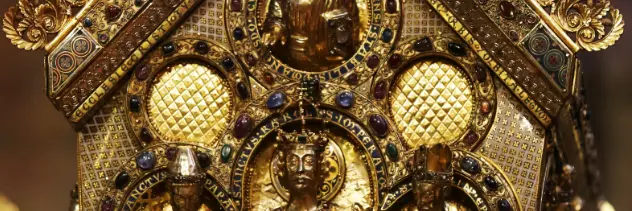
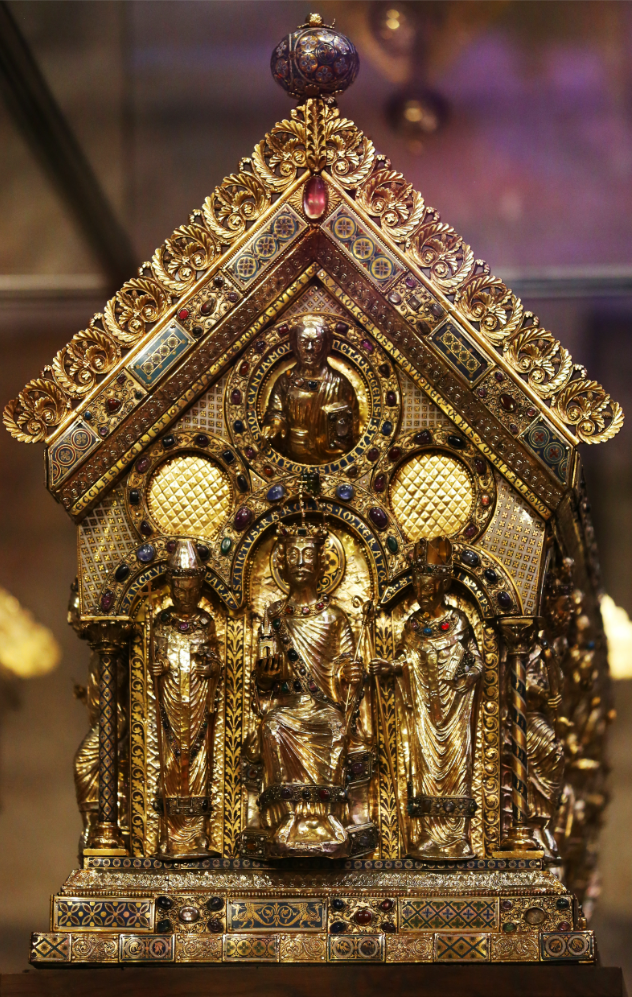
Charles IV of Prague, who was crowned Holy Roman Emperor in 1346 and 1349, was also a fan. He is thought to have been the donor behind this spectacular reliquary, containing Passion relics of Christ and, most prominently, a supposed arm bone (which is actually a leg bone) of Charlemagne. Among the other relics in the reliquary is a tooth of St Katherine, who had been Charles’s personal patron saint ever since his victory in the Battle of San Felice on St Katherine’s day (25th November) 1332. The reliquary also holds three teeth of Charlemagne. In 1349, at his imperial coronation in Aachen, Charles IV had received a ‘gift’ of three teeth of Charlemagne to take back to Prague with him. Charles IV was notorious for swiping relics everywhere he went. Religious houses and cathedrals were forced to give ‘diplomatic gifts’ of whatever relic Charles wanted. To avoid the risk of losing their precious relics, sometimes monks and clerics would hide them in advance of his arrival: if he didn’t see them, he couldn’t ask for them! But this time, at least, Charles seems to have returned the relics back to the cathedral treasury at Aachen, suitably and splendidly framed for public display.
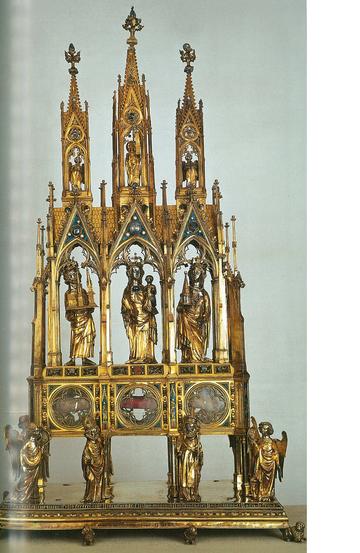
Charlemagne is the gilt figure standing on the far left of the reliquary, with the Virgin Mary in the centre and St Katherine on the far right. He is holding a miniature church: a model of Aachen Cathedral, celebrating the emperor’s role as founder.
Reference:
Herta Lepie and Georg Minkenberg, The Cathedral Treasury of Aachen (Schnell and Steiner: Regensburg, 2010)
After the workshop in Liège, the MALMECC team went to visit Charlemagne’s palace chapel in Aachen, also known as Aix-la-Chapelle. Charlemagne (742-814) was one of the greatest medieval rulers. Starting out as king of the Franks, his Frankish empire spread to cover large parts of present-day France, the Benelux countries, Germany and Italy. In 800, he was crowned ‘Emperor of the Romans’ by Pope Leo III in Rome, marking the start of the Holy Roman Empire.
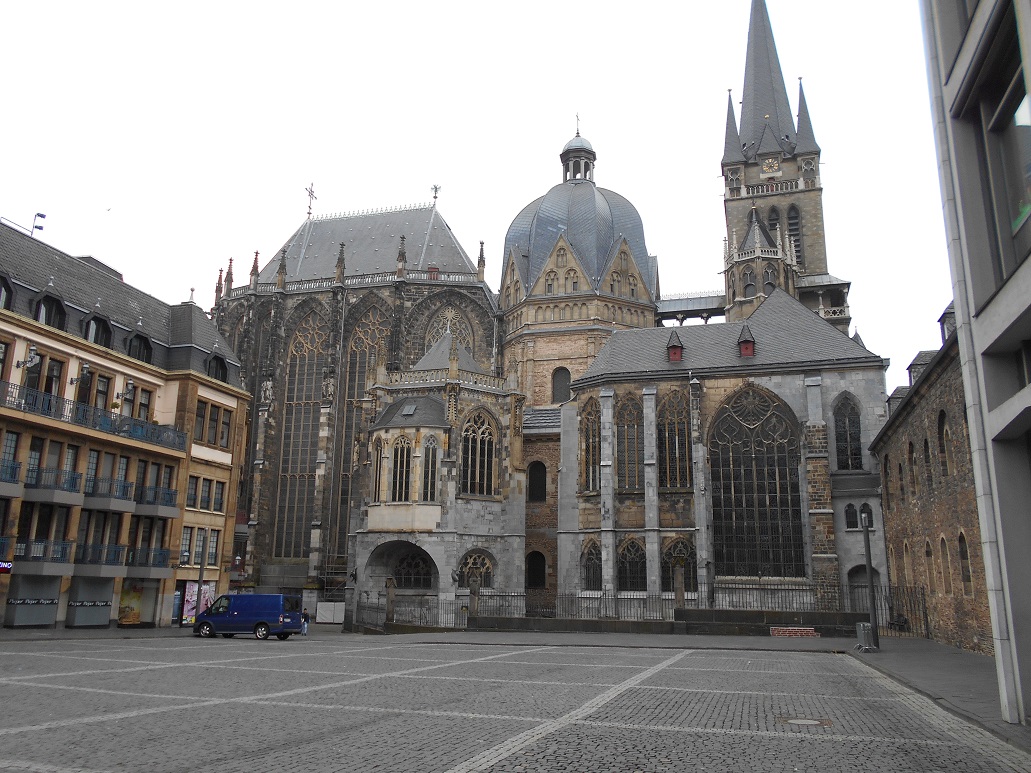
The courtyard of Aachen Cathedral
Charlemagne and his son, Louis the Pious, oversaw what has been called the ‘Carolingian Renaissance’: a revival of art, scholarship, classical learning and Christian culture that saw men such as Alcuin of York become master of the palace school in Aachen, where he taught Charlemagne and his family alongside young men sent to school at the Carolingian court. Aachen became the imperial capital of the Carolingian dynasty. Charlemagne built a grand palace (which no longer exists) and a palatine chapel that today forms the heart of Aachen Cathedral.
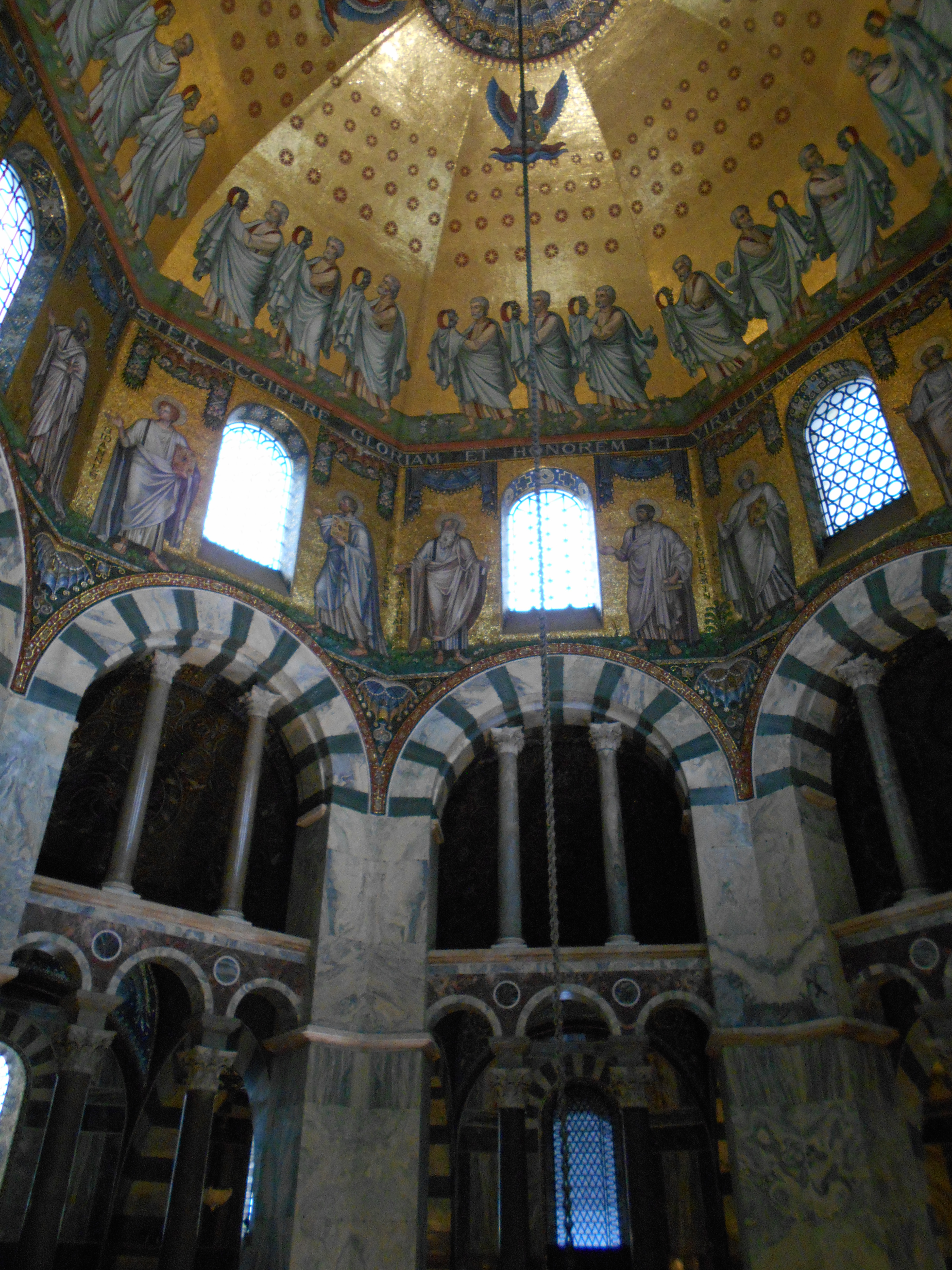
Charlemagne’s palace chapel was built around 792 and dedicated to the Virgin Mary. It is a centrally planned building topped by an octagonal dome.
The architectural plan recalls the Church of the Pantheon in Rome, a former Roman temple rededicated to the Virgin. It also echoes two of the holiest places in Jerusalem: the Anastasis Rotunda housing the tomb of Christ in the Church of the Holy Sepulchre, and the circular Dome of the Rock, the Islamic holy place built c. 692 on the Temple Mount.
The mosaic decorations of the palatine chapel at Aachen are very similar to those found in the interior of the Dome of the Rock today.
Ceiling mosaic showing the four rivers of Eden (image courtesy of theladytravels)
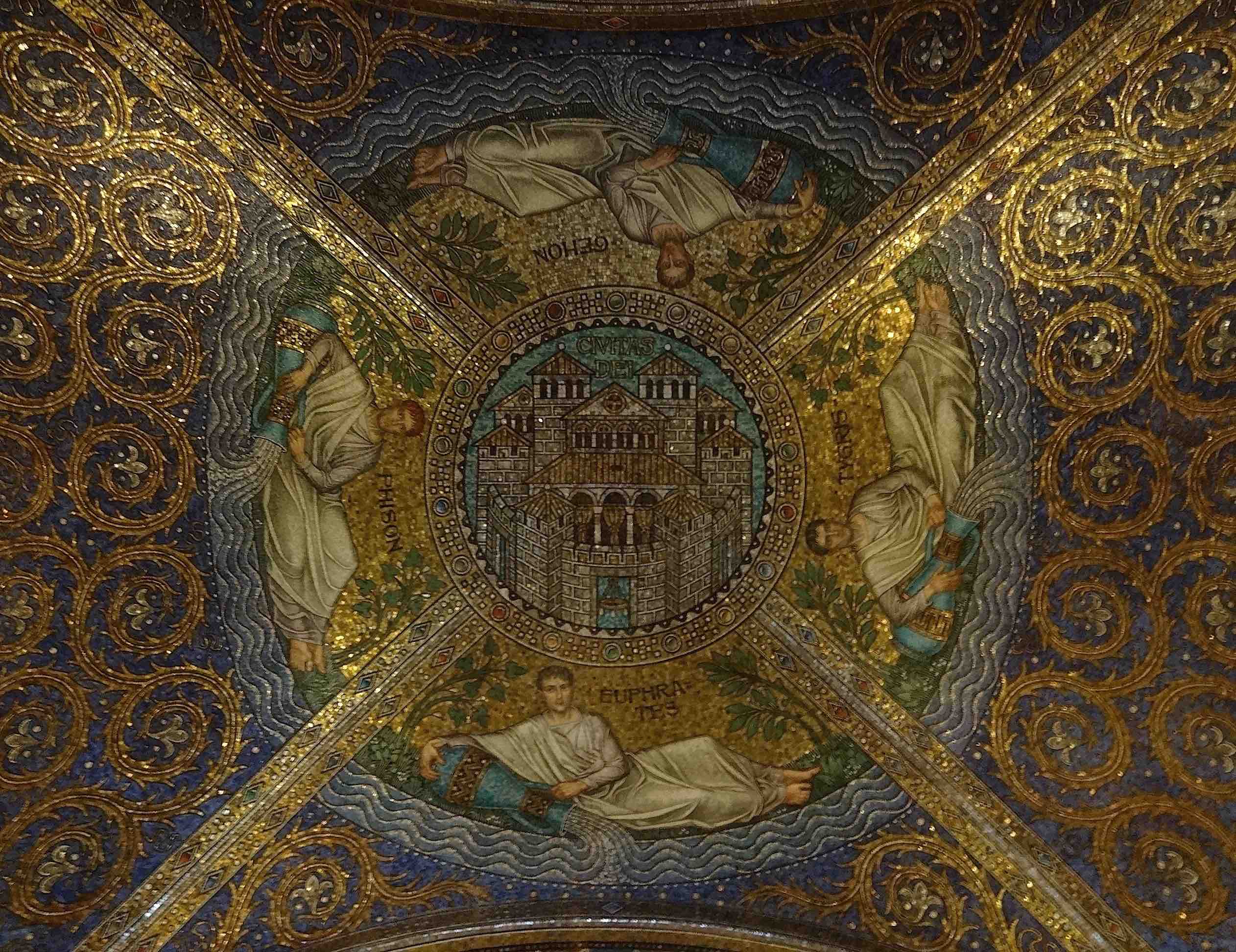
Both interiors draw on Biblical descriptions of the interior of the Temple of Solomon, as in 2 Kings 3:5-7:
‘And the greater house [the Temple] he [Solomon] ceiled with deal boards, and overlaid them with plates of fine gold throughout: and he graved in them palm trees, and like little chains interlaced with one another. He paved also the floor of the temple with most precious marble, of great beauty. And the gold of the plates with which he overlaid the house, and the beams thereof, and the posts, and the walls, and the doors was of the finest: and he graved cherubims on the walls.’
Charlemagne and the Umayyad Caliph Abd al-Malik were deliberately echoing the rich marble and mosaic work seen in early Christian and Byzantine churches in Rome, Constantinople and Jerusalem. This was a decorative language rooted in the Biblical precedent set by Solomon for works of great beauty and holiness. It was also now closely associated with ancient imperial Roman and Byzantine power. By appropriating this visual language, Carolingian and Islamic buildings could communicate a similar sense of sacred power and holy magnificence.
Charlemagne clearly wanted his palace buildings in Aachen to rival the medieval world’s most ancient and important Christian and imperial capitals. The chapel’s similarities with the basilica of San Vitale in Ravenna are not accidental: this was another former Roman imperial, Ostrogothic, Byzantine and Lombard capital city, which Charlemagne had visited multiple times.
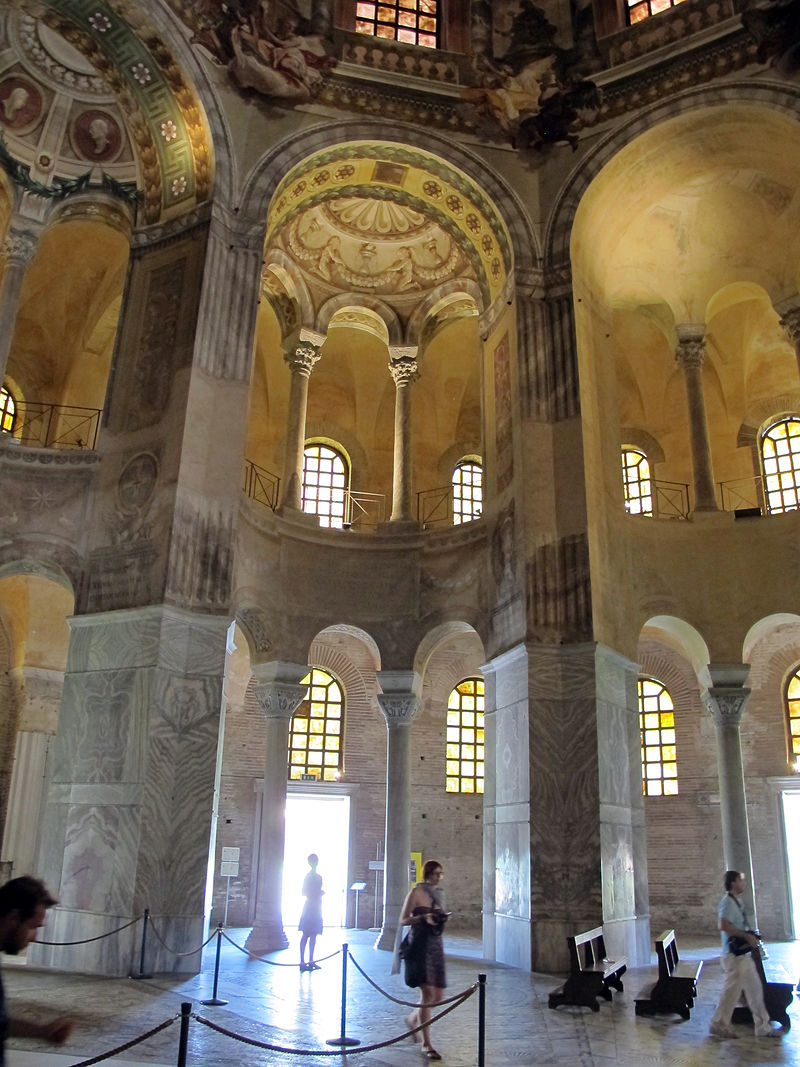
The interior of San Vitale in Ravenna, showing marked similarities with the palace chapel at Aachen
The palatine chapel we see at Aachen today was heavily restored by Kaiser Wilhelm II in the nineteenth century, although the iconography of its decoration was carefully and closely copied. The famous Throne of Charlemagne still survives in the upper storey of the chapel. It again echoes the Biblical Throne of Solomon, and may incorporate spolia [repurposed stone] from the Holy Sepulchre in Jerusalem.
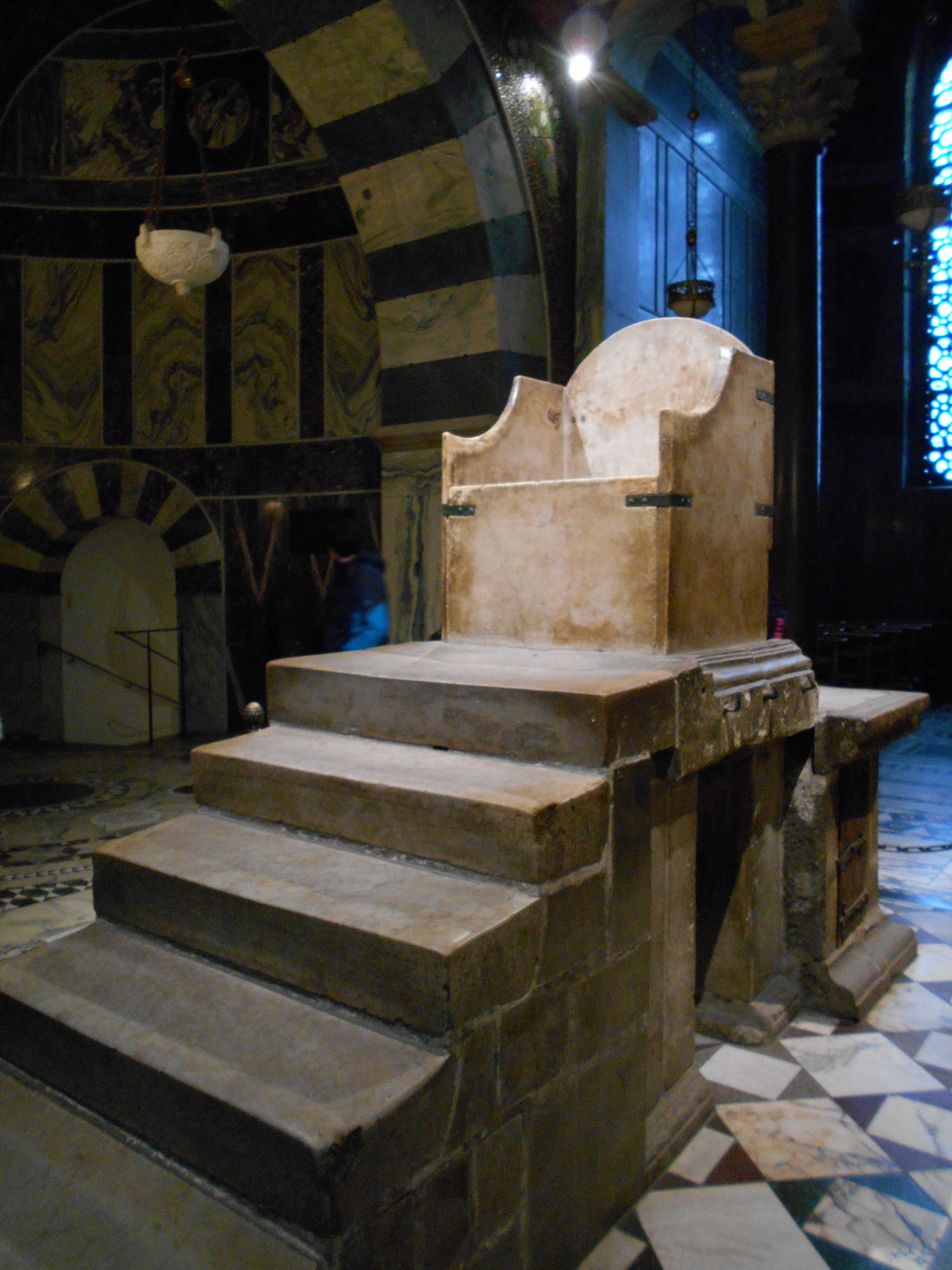
Read our next post to find out just what influence Charlemagne had on the court cultures of late medieval Europe….
In her final post in this series, Laura looks at the role of music in the images of the Ghent Altarpiece, where holy sounds seem just as important as holy sights. To read Laura's other work on the altarpiece, please see the preceding posts.
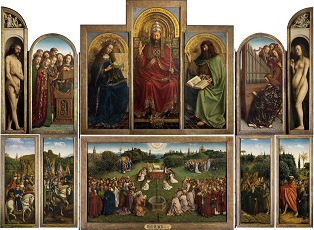
A full image of the Ghent Altarpiece which will allow you to zoom into the details can be found via Wikipedia by clicking here.
The churchmen seen in the lower register with their service books, joining in with the Mass in song, have been identified by art historian Elizabeth Dhanens as three contemporary popes, all wearing the jewelled papal tiara: Martin V (in profile nearest to the service book), the ‘antipope’ Alexander V, and Gregory XII. Whatever schisms have occurred on earth, all three have been admitted to the Kingdom of Heaven.
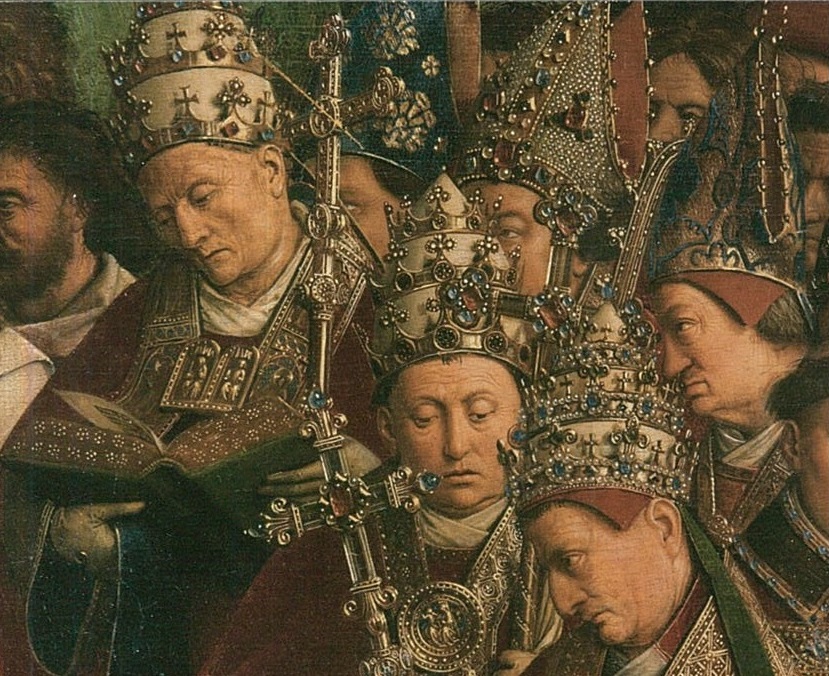
We can see musical notation in the service book in front of them, and it’s not the only glimpse of music in Ghent Altarpiece. In the upper levels, we see figures (usually identified as angels, although we cannot see any wings) singing and playing instruments.
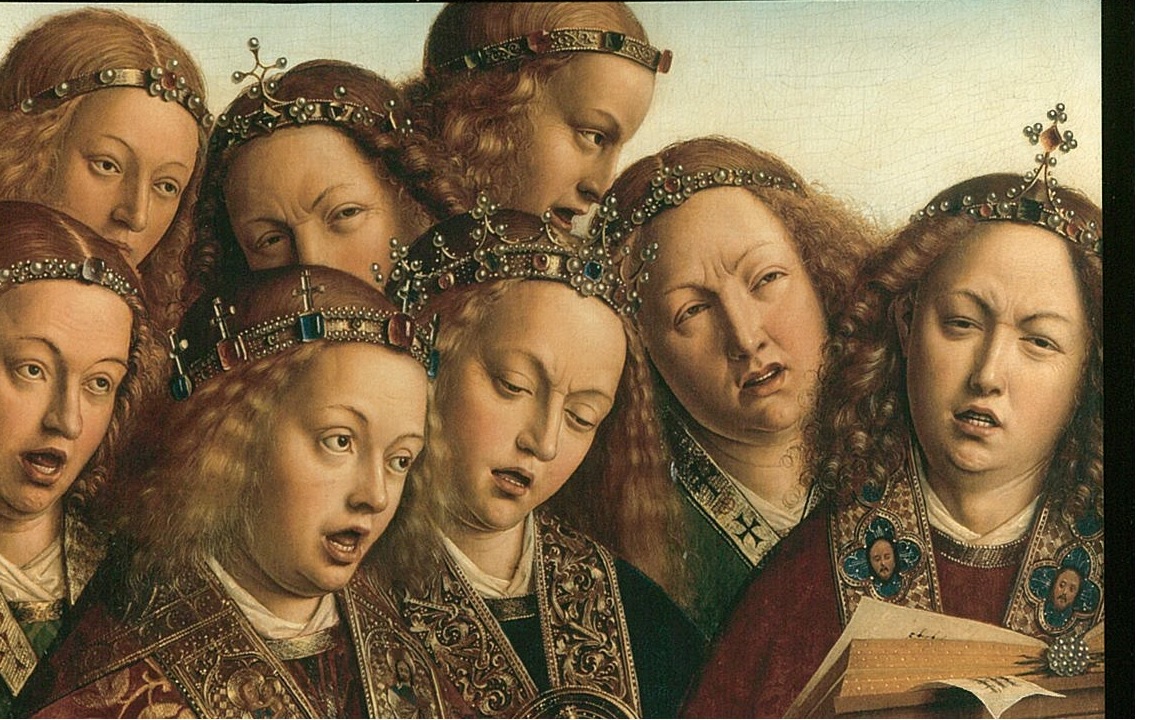
Frowning and focusing hard on their singing, the angels are clearly concentrating- perhaps to keep in time, as if they are singing elaborate, fashionable polyphonic music. The panel may again allude to the singing that accompanied the service of the Mass, as well as the eternal, unceasing praises of God sung by the heavenly choir described in Revelation 5: 9-13, ‘And they sung a new canticle…’. The angelic singers wear the clerical robes worn by deacons and subdeacons and are grouped around a pulpit with a carved image of St Michael the Archangel defeating Satan below. Referring to the events described in Revelation 12: 7-9, here is another allusion to the Last Judgement and the heavenly Paradise that awaits afterwards. Along the bottom of the pulpit is a carved border of fruits and vines, another reference to the blood of Christ and the wine of the Eucharist (John 15:1, ‘I am the true vine’). The tiles below them include images of the Lamb of God and the monograms of Jesus and Mary. Below the singers is an inscription: ‘Melos deo laus perhennis gratiarum actio’, which Elizabeth Dhanens translates as: ‘Songs of supplication, songs of praise, songs of thanksgiving’
The angels gathered around the pipe-organ on the viewer’s right of the altarpiece, playing a harp and viol, are in the same (heavenly?) place, as we see the same tiles beneath their feet. And there is another inscription, this time a quote from Psalm 150:4, ‘Laudate eum in cordis et organi’, ‘Praise him with strings and organs’. Whether on earth watching the performance of the Mass or in heaven, flanking Christ, the Virgin and St John the Baptist, holy sights and holy sounds came together.
References:
Craig Harbison, Jan van Eyck: The Play of Realism (London, 1991)
Elizabeth Dhanens, Van Eyck: The Ghent Altarpiece (London, 1973)
Barbara Haggh, ‘The Mystic Lamb and the Golden Fleece: Impressions of the Ghent Altarpiece on Burgundian Music and Culture’, Revue belge de Musicologie / Belgisch Tijdschrift voor Muziekwetenschap 61 (2007): 5-59.